A Measurement Model for Ads in AI Conversations
 JR Santosdiaz

Most AI-influenced engagements get credited to something else. Here’s how Koah measures ads in AI conversations, using the IAB’s new framework to credit what happens before the click.
TL;DR
- Last-click attribution pushed some ad networks to game the final interaction, whether a click or a view. Inflated numbers made reports look better and did little to show advertisers where their spend drove ROI.
- AI conversations shape people’s actions, and the credit usually goes somewhere else, because people leave the chat and act on it later through search or a direct visit.
- The IAB’s new framework distinguishes between sales that are AI-Influenced and AI-Recommended. Each supports a different claim.
- Koah measures engagement inside the ad, grades clicks by quality, matches each signal to the claim it supports, and lets advertisers check the numbers against their own data.
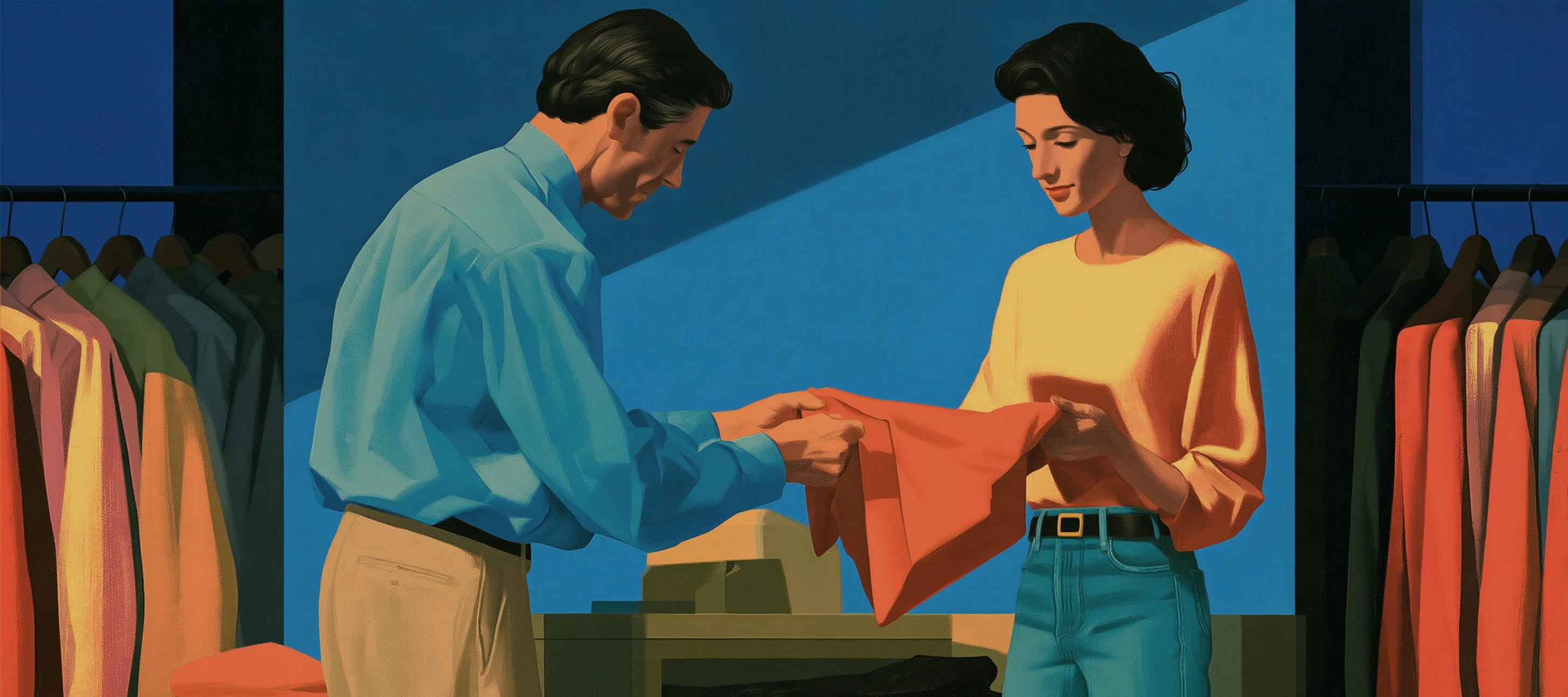
Picture a good salesperson helping you buy a camera. They ask what you plan to photograph, how much you want to spend and whether you care more about portability or image quality. They narrow a wall of cameras down to two models, walk you through the tradeoffs and recommend one.
You thank them, go home, and order that exact camera directly from the retailer’s website. The retailer’s records say its website made the sale. The salesperson who helped you choose gets zero credit.
That’s what happens to AI in most attribution reports today. More than half of the commercial-intent prompts across our network come from people who haven’t decided what to buy yet. Those conversations run longer than a typical conversation and contain more detail than traditional search. Yet as Similarweb reports, 9 in 10 AI-influenced visits are credited to something else.
- AI
- 8.8%
- Search
- 55.9%
- Direct
- 19.9%
- Referrals
- 13.5%
- Other
- 1.9%
- Note
- US desktop visits after an AI assistant recommended a brand.
- Source
- Similarweb, The Downstream Impact of AI Visibility, June 2026
Attribution has always had blind spots
In mobile advertising, last click attribution is the currency. Even so, attribution has never given the industry a complete or causal view of the customer journey. Signal loss, walled gardens and offline purchases all predate AI. Last click was the best estimate we could agree on.
It also shaped behavior. When privacy changes made users harder to track, networks competed on the clicks they could still claim. Taps on a playable, misses aimed at a tiny ‘X’ button and automatic app store overlays all started counting as clicks. Click-through rates that used to sit in the low single digits were reported as high as 24%. Once one network inflated its numbers, everyone else had to follow or look weak in a head-to-head test.
Picture the camera store again, but now the commission goes to whoever rings up the sale, regardless of who helped the shopper choose. The salesperson who spent 20 minutes comparing cameras gets no credit. The person at the register gets paid. Before long, salespeople stop advising customers and start crowding the register, so they’re the last person involved in the purchase.
This has been compared to the tragedy of the commons. Each network gains by grabbing attention more aggressively, and the shared resource, user trust, decays for all players. Ironically, everyone building these ad systems is also a user, so we all understand how this negatively affects the user experience.
We are building Koah to leave the ad tech ecosystem better than we found it. Bringing mobile’s click economy into AI conversations would do the opposite. A conversation is about as personal as an ad placement gets, and a measurement system that rewards the rush to the conversion will fill it with ads using more aggressive tactics than the last.
The AI journey moves differently
The closest comparison in the old playbook is connected TV. A CTV ad surfaces intent on the living room screen, and the install or purchase happens later on mobile or desktop.
AI goes further than CTV in three ways.
- It shapes the decision as well as the intent. A CTV ad puts a brand in your head. An AI conversation goes a step further by helping narrow your options and sharpen your choice.
- It includes research. After seeing a CTV ad, shoppers still research, read reviews and browse comparisons before they convert. In AI, the intent, research, and decision collapse into one chat, so users arrive at checkout already decided.
- Agents can now execute purchases. An agent with permission can buy on the shopper’s behalf without a browsing session at all.
The IAB’s framework
The IAB’s AI-Era Attribution Blueprint gives the industry a shared way to classify each sale by first asking three questions at the point of purchase: Who created the intent? Who made the decision? Who completed the transaction?
The answers sort every sale into one of three pathways: Human-Owned, AI-Assisted or AI-Executed. Each pathway then determines who can claim influence and what evidence that claim needs.
For anyone buying ads in AI, the most significant classification in the framework runs through the AI-Assisted categorization:
- AI-Influenced: AI shaped what the shopper wanted, and the shopper made the final choice. This is the salesperson who helped you understand why a certain camera made sense, but you went home, did more research and chose a model on your own.
- AI-Recommended: AI shaped the final choice itself. This is the salesperson from the opening example who compared two cameras and recommended one, and you bought that exact model.
AI-Influenced
AI shapes what the shopper wants. The shopper makes the final choice.
- Intent
- AI
- Decision
- Human
- Execution
- Human
AI-Recommended
AI shapes the final choice. The shopper accepts it.
- Intent
- Human or AI
- Decision
- AI
- Execution
- Human
- Source
- IAB, AI-Era Attribution Blueprint, November 2026
The two carry different claims. An AI-Influenced sale works like awareness advertising and can support a contributory claim. An AI-Recommended sale can support a decision claim, the strongest in the framework, but only with evidence that AI shaped the final pick. When the evidence can’t tell the two apart, the IAB allows only the weaker claim.
The IAB also admits this is the hardest distinction to make as both journeys can look identical in a retailer’s data. That’s the measurement challenge we’re solving at Koah.
How we measure AI ads at Koah
Closing the measurement gap starts with better evidence. Here are the four ways we collect it and connect it to the final interaction.
1. Measure more than the click
Our interactive ad formats ask people to do something inside the conversation. People vote in a poll, swipe through a catalog, tap an answer in a quick pick, choose a price range in a budget finder and open an expandable for more detail.
We record these engagements separately from clicks because these interactions are evidence. A user may never tap “Buy Now” and still compare a brand’s options, swipe through and pick a favorite. That’s interest and intent showing up before the click. A passive impression can’t do that.
2. Stop treating every click the same
A click on a call to action, a tap on a product inside a catalog and a tap near the edge of the ad are different events. In mobile advertising, they all got counted as one. The idea of a hierarchy of click types has been around for a while. It grades each interaction by quality, so the click stops being the only engagement that counts.
We’re building that framework for AI formats. It places each interaction at a stage of the customer journey. A vote in a poll shows interest. Choosing a budget range shows a decision taking shape. A tap on a call to action shows readiness to act. People often engage with an ad, leave, and convert days later, so each interaction class gets its own downstream conversion rate and its own attribution window, estimated from observed outcomes and re-estimated as the sample grows. An interaction that predicts conversions gets more weight. That removes the incentive to manufacture low-quality clicks, the kind that defined the last era of advertising.
3. Match the evidence to the claim
We map each signal to the IAB pathway it can support. Exposure alone supports, at most, a contributory claim, and we only make it with lift data from a holdout. An in-format selection that matches what the person later bought, downloaded, or signed up for is evidence that the conversation shaped the decision, which places the conversion in the AI-Recommended pathway.
We keep measured and estimated results separate. Conversions tied to a Koah click ID are measured. Conversions we match through other signals are estimates, and we report them separately.
4. Let advertisers verify our work
Every measured conversion we report is tied to a Koah click ID and comes back through our pixel, our Conversions API or the advertiser’s mobile measurement partner, so the advertiser can reconcile our numbers against their own. We also hold first-party data no outside tool can see: what the user did inside the ad. We’re bringing that into our reporting alongside conversions, so an advertiser can see which interactions drove conversions.
A network grading its own homework has never earned much trust, and it shouldn’t. An advertiser’s own data, or an independent measurement partner’s, should be the source of truth. Our job is to give them clean inputs.
What we’re building
Give the commission to whoever rings up the sale, and you get a crowded register. Credit the salesperson who actually helped you choose, confirm it against the sale, and you get a better shopping experience that brings customers back.
That’s the measurement system we want for AI. It rewards ads that help someone decide, and it keeps consumer AI products free, because advertisers keep funding a channel they can trust.
If you’re running ads in AI and want to see what they do before the click, talk to Koah.